Aloha Airlines Flight 243: Landing a 737 With Its Roof Torn Away
The short version
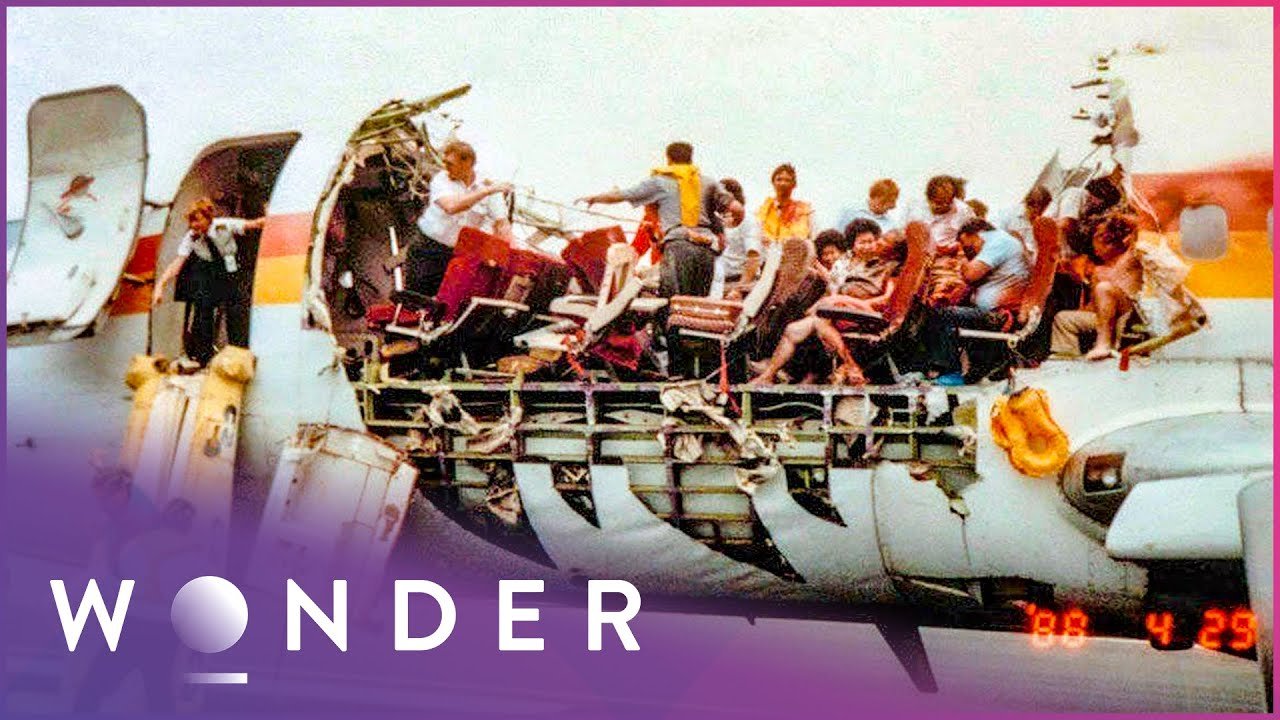
This full Mayday episode reconstructs Aloha Airlines Flight 243 on 28 April 1988, when an explosive decompression tore away part of the 737's upper fuselage at 24,000 feet over Hawaii. It follows the crew's descent and landing at Kahului with no nose-gear indication, and then the NTSB investigation. One flight attendant died, and the other 94 people on board survived.
Full written account
This is the full Mayday episode on Aloha Airlines Flight 243. The first half reconstructs the flight with the crew's radio calls and passengers' accounts. The second half, also released as a shorter film, follows the NTSB investigation.
The ninth flight of the day
At 1 pm the 737 was preparing to leave Hilo for Honolulu, a 35-minute hop and its ninth flight of the day. Captain Bob Schornstheimer had 11 years with Aloha, and First Officer Mimi Tompkins nearly nine. The senior flight attendant, C.B. Lansing, had been flying for 37 years. The airplane had made more than 89,000 flights. Passenger Gail Yamamoto noticed something on the fuselage while boarding. Patricia Aubry moved from row 1 to row 17 on an impulse. The airplane took off at 1:25.
The decompression
Twenty minutes later, levelling at 24,000 feet, about 35 square metres of fuselage tore away. Flight attendant Jane Sato-Tomita was struck by debris at row 2, Michelle Honda was thrown to the floor at row 15, and C.B. Lansing was gone. The first five rows were open to the sky. The episode explains the dangers that followed: hypoxia, with no oxygen supply to the passengers because the tubing was severed, freezing air and wind about three times hurricane force.
The descent
The captain took over and descended at about 1,200 metres a minute. With the nose sagging and the cockpit cut off from the cabin, Michelle Honda shouted to passengers to ask whether anyone could fly a plane. Tompkins could not reach Honolulu and switched to the tower at Kahului, which had trouble hearing the airplane. The crew reported that the flight controls felt as though the hydraulics had failed, and the left engine was lost.
No nose gear light
With the gear down, the nose gear light stayed out. The textbook answer would be a low pass for the tower to check the gear, but with an airplane that might break apart, the captain decided to land anyway. Tompkins calculated an approach speed of 152 knots for a flap 5 landing. The crew flew the approach faster than normal to keep control. The tower then reported that the gear appeared down. The winds, often strong on that approach, had died away. The airplane touched down and stopped, and the crew shut it down.
The investigation
The second half of the episode covers the same ground as the shorter cut. It shows why the forward fuselage stayed attached, how NTSB metallurgist Jim Wildey found fatigue cracks beside rivet holes in disbonded, corroded lap joints, how Boeing's earlier warnings and the FAA's directives were handled at Aloha, and why the tear straps did not stop the tear. It also covers Matt Austin's fluid hammer theory, which the NTSB said was scientifically valid but did not change its probable cause.
Legacy
Aloha's management took most of the blame, the NTSB pressed the FAA to enforce maintenance standards, and Congress passed the Aviation Safety Research Act. The episode ends with survivors describing how they recovered, and the memorial garden for C.B. Lansing at Honolulu airport.
Questions this video answers
How many people were aboard Aloha Airlines Flight 243?
There were 95 people aboard. One flight attendant died.
Where did Flight 243 land?
The crew diverted to Kahului Airport on Maui rather than continuing to Honolulu.
What caused the fuselage to break open?
Investigators found fatigue cracking around rivet holes and deterioration of the bonded fuselage joints. They attributed the accident to metal fatigue and poor maintenance.
Was the nose landing gear actually down?
Yes. Although its cockpit indicator did not illuminate, the gear was seen extended before touchdown and held during landing.
Did investigators accept the fluid-hammer theory?
The NTSB considered it scientifically valid but said the evidence still supported nearly simultaneous failure at multiple weakened points. Its probable cause remained unchanged.
Explore related events
Connected by the topic: Maintenance error