Tenerife Airport Disaster: The Radio Calls Behind 583 Deaths
The short version
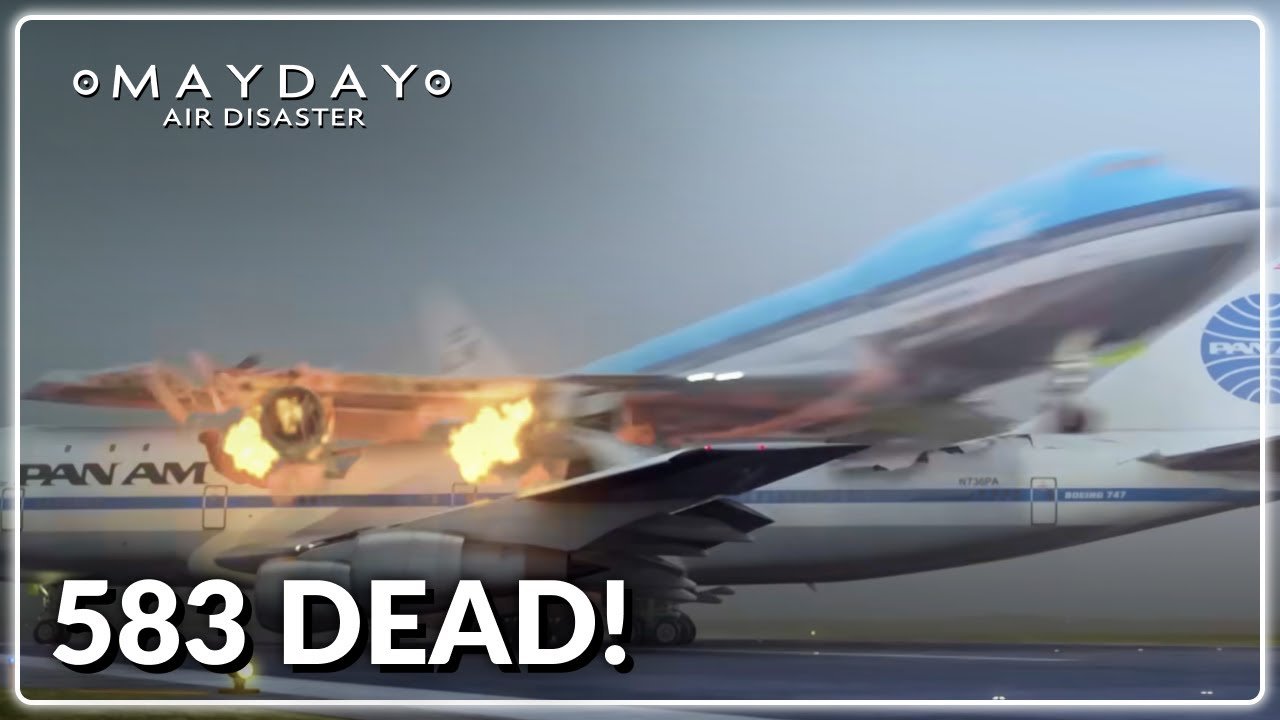
This Mayday episode follows Spanish, Dutch and American investigators as they reconstruct how a KLM 747 and a Pan Am 747 collided in fog at Tenerife in March 1977. It covers the bomb diversion, the KLM refuelling that held up Pan Am, the confusing runway exit and the two radio calls that blocked each other. It ends with the KLM captain's background and the crew resource management training that followed.
Full written account
On 27 March 1977, two Boeing 747s collided on the runway at Los Rodeos Airport on Tenerife, killing 583 people. This Mayday episode reconstructs the investigation, with interviews including Pan Am first officer Robert Bragg, a controller's account of the tower and NTSB investigators who synchronised the cockpit recordings.
A crowded island airport
A terrorist bomb had closed the airport at Las Palmas, and dozens of flights were diverted to Los Rodeos, a single-runway airport with one parallel taxiway. Parked aircraft blocked the taxiway, so controllers had to send departing aircraft along the runway itself. The tower had no ground radar.
Pan Am Flight 1736, flown by Captain Victor Grubbs, First Officer Robert Bragg and Flight Engineer George Warns, had come from Los Angeles via New York. When Las Palmas reopened, they could not get past a KLM 747 that had begun refuelling; the KLM crew said it would take about 45 minutes.
Fog and a confusing exit
The airport, high on the island, was prone to cloud rolling across the runway. As both 747s began to move, visibility fell almost to zero. The tower sent KLM to the end of the runway to turn around, and told Pan Am to follow and leave at the third exit on the left. Pan Am had to ask twice to confirm.
Investigators found that the third exit required two turns sharper than 90 degrees, practically impossible for a 747. The fourth exit, at about 45 degrees, was much easier, and the Pan Am crew appear to have been heading for it.
Duty-time pressure
KLM Captain Jacob van Zanten was one of the airline's most senior pilots, head of its flight training department. The KLM cockpit recording showed him worrying about new Dutch duty-time rules, which could cost a captain his licence if exceeded. He refuelled at Tenerife to save time at Las Palmas, but the airport reopened while he was still refuelling, and the weather worsened.
"We are now at takeoff"
At the end of the runway, the first officer asked for the air traffic control clearance, the route to fly after departure. The controller replied with the route, ending "right turn after takeoff". The captain began the takeoff before the readback was finished, and the first officer added "we are now at takeoff". The controller replied "okay", then "stand by for takeoff, I will call you". At the same moment Pan Am transmitted "we're still taxiing down the runway". The two calls produced a four-second squeal in the KLM cockpit; the crew heard only "okay".
A moment later the tower asked Pan Am to report when clear. The KLM flight engineer asked: "Is he not clear then, that Pan American?" The captain answered emphatically that he was.
The collision
Bragg saw the KLM landing lights coming through the fog, and Captain Grubbs turned hard left. The KLM 747 lifted off but struck the top of the Pan Am fuselage. It crashed further down the runway and burned. On the Pan Am aircraft, survivors escaped through openings in the torn fuselage and onto the wing, some jumping to the runway. All 248 people on the KLM jet were killed, along with 335 on the Pan Am jet; 61 survived.
Why an experienced captain took off
The programme notes that van Zanten had flown little in recent months and had spent much of his time training pilots in simulators, where there is no air traffic controller and the instructor gives his own clearance. Investigators also pointed to the captain's status: junior crew members were reluctant to challenge him.
What changed
The word "takeoff" is now used by controllers only for an actual takeoff clearance; otherwise they say "departure". Airlines, including KLM, changed how captains work with their crews, which grew into crew resource management.
Questions this video answers
How many people died?
583 people died: 248 on the KLM flight, where there were no survivors, and 335 on the Pan Am flight.
Why were the jets at Los Rodeos?
Flights were diverted there after a terrorist bombing shut down the airport at Las Palmas.
Why did the KLM crew not hear the stand-by instruction?
The tower and the Pan Am crew transmitted at the same moment, producing a 4-second squeal in the KLM cockpit; the crew heard only the word 'okay'.
What changed afterwards?
The video says the accident led to crew resource management training and to controllers avoiding the word 'takeoff' unless a takeoff is intended.
Explore related events
Connected by the topic: Boeing 747