TWA Flight 800: How a Wiring Fault Ignited an Empty Fuel Tank
The short version
TWA Flight 800 broke apart over the Atlantic in July 1996 when a short circuit most likely sent excess voltage into the fuel gauge wiring of its nearly empty centre tank, igniting fuel vapour warmed by the air conditioning packs below. Airline captain Petter Hörnfeldt explains the tank design, the ageing wiring, the breakup sequence and why witnesses mistook the burning fuselage for a missile. He ends with fuel tank inerting and the wiring rules that followed.
Full written account
TWA Flight 800 broke apart about 12 minutes after leaving New York for Paris on 17 July 1996, killing all 230 people on board. In this long explainer, airline captain Petter Hörnfeldt sets out why a nearly empty fuel tank exploded and why the missile theory does not fit the evidence.
A 25-year-old 747 and a nearly empty tank
The Boeing 747-131, N93119, had been delivered to TWA in 1971 and had flown about 93,000 hours. That afternoon it arrived at JFK from Athens. For the trip to Paris, with the aircraft about half full, all the fuel went into the wing tanks. The centre wing tank held only about 135 kg of fuel that the pumps could not reach, spread across a tank of about 48 cubic metres.
On the flight deck were a 58-year-old captain in captain upgrade training, a 57-year-old check captain, and a flight engineer trainee with an instructor. In the cabin were 212 passengers and 14 flight attendants.
Warming the tank on the ground
Departure was delayed: the fuel shut-off valve stopped refuelling early, a bag had to be checked and a broken-down service vehicle blocked the pushback. Throughout, the air conditioning packs ran on a 27 °C day. On the 747-100, two packs sit directly below the centre tank with little insulation, so their heat warmed the residual fuel and pushed the vapour into the flammable range.
That was not unusual: flammable vapour in fuel tanks was considered unavoidable, and safety relied on keeping ignition sources out. The video recalls earlier fuel tank explosions, including Pan Am Flight 214 in 1963 and a Philippine Airlines 737 at Manila in 1990, which showed that this approach was not foolproof.
The fuel quantity wiring
The 747's fuel quantity indicating system measures fuel with capacitance probes inside the tanks. It runs on so little energy that a spark from it should be about twelve times too weak to ignite vapour. But that only holds if the wiring is kept apart from higher-voltage circuits. There was no FAA rule requiring separation, and on Boeing aircraft the fuel quantity wires shared bundles with power wiring. Ageing insulation, metal shavings from maintenance and silver sulphide deposits on wiring inside the tank all made a stray current and an arc more likely. Later inspections of in-service airliners found damaged and previously arced wiring was common.
The last minutes
The 747 took off from runway 22R about 20:19. At 20:29:15, climbing through about 13,000 ft, the captain said: "Look at that crazy fuel flow indicator there on number four. You see that?" The cockpit voice recorder also caught two brief drops in background power. The wiring for that gauge and for the recorder shared a bundle with fuel quantity wiring for the centre tank.
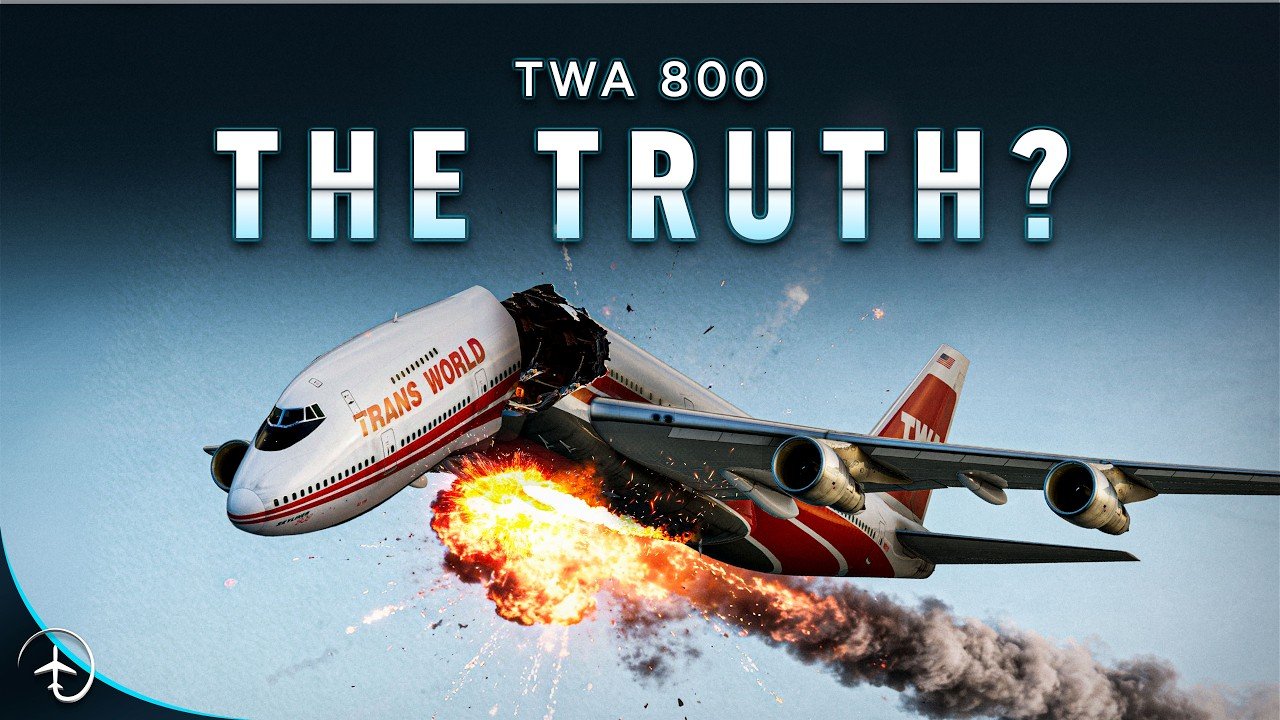
At 20:31:12 a spark inside the tank ignited the vapour. The flame front spread through the tank and the overpressure broke internal beams, the front spar and the keel beam. Within about three to five seconds the forward fuselage, including the cockpit, separated.
Why witnesses thought they saw a missile
Without its nose, the rest of the aircraft pitched up and climbed several thousand feet while trailing burning fuel, then stalled and fell. The wings broke away and their fuel produced a large fireball. Seen from shore, this looked like a streak of light rising to an explosion. The video explains that real missiles burn out quickly and are rarely visible near their target, and that the wreckage showed none of the fragment damage seen in aircraft actually hit by missiles, such as Malaysia Airlines Flight MH17. Trace explosive residue found in a few places was not in any consistent pattern.
Investigation and legacy
More than 95% of the aircraft was recovered from the seabed and reconstructed. The NTSB's final report found the centre tank explosion was most likely triggered by a short circuit outside the tank that let excess voltage in through the fuel quantity wiring, and that the design philosophy of relying only on excluding ignition sources had been flawed.
Fuel tank inerting systems, which fill tanks with nitrogen-enriched air, became mandatory, and wiring inspection, separation and maintenance standards changed throughout the industry. For another accident that reshaped how ageing aircraft are inspected, see Aloha Airlines Flight 243.
Questions this video answers
What caused TWA Flight 800 to crash?
Investigators concluded that a fuel-air explosion in the center wing tank, almost certainly initiated by a short circuit involving fuel quantity indicating system wiring, broke up the aircraft.
Was TWA 800 shot down by a missile?
The physical evidence did not support it: there was no widespread fragment peppering and no high explosive residue in any consistent pattern. The streak witnesses saw was likely the burning rear part of the aircraft still climbing.
How many people died?
All 230 people aboard were killed.
What changed afterward?
Regulators mandated fuel tank inerting systems that pump nitrogen into empty tanks, and wiring, inspection and maintenance practices changed.
Explore related events
Connected by the topic: Boeing 747