Japan Air Lines Flight 123: How the Bulkhead Burst Took the Tail
The short version
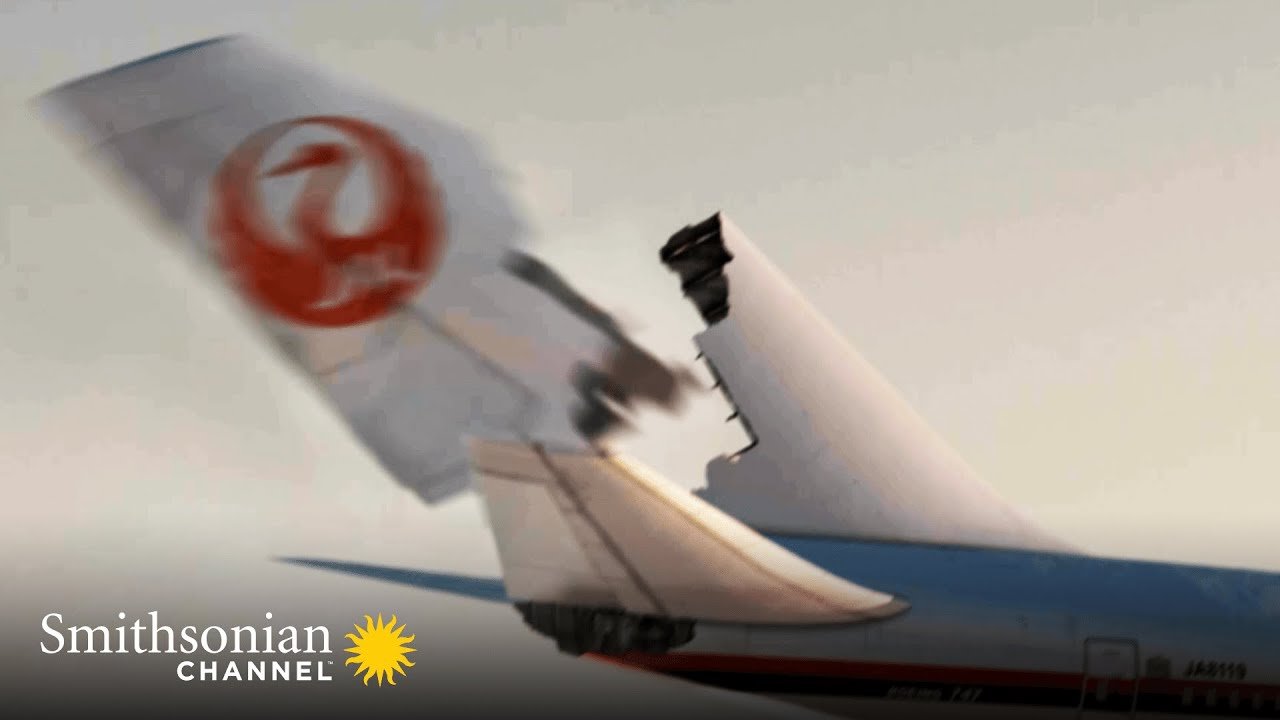
This four-minute Smithsonian Channel clip explains the mechanism of the Japan Air Lines Flight 123 accident in 1985. It shows how a faulty repair let the rear pressure bulkhead crack and burst near 24,000 feet, how the escaping air blew off the tail fin and cut the hydraulic lines, and why simulator crews could not land the aircraft afterwards.
Full written account
This clip from Smithsonian Channel's Air Disasters series focuses on the engineering of the Japan Air Lines Flight 123 accident. It joins the story as the 747 climbs towards 24,000 feet.
The bulkhead
The narrator explains that the cabin is pressurised while the tail behind the rear pressure bulkhead is not, so every climb stretches the bulkhead. On JA8119 a faulty repair made that joint weak. The clip shows a test that reproduced those conditions, with cracks lengthening around the rivet holes until the bulkhead failed. On Flight 123 the burst opened a hole of about 30 square feet, brought down the ceiling around the rear toilets and sent the cabin air into the tail fin, which broke off.
Thirty minutes in the air
Without the tail, and with the hydraulic lines cut, the pilots could not use the rudder or the other flight controls. The narrator explains the phugoid motion that followed: the nose drops, the aircraft speeds up and climbs, slows, and drops again, sometimes by several hundred feet at a time. An investigator interviewed in the clip calls it a miracle that the crew kept the aircraft flying for 30 minutes or more, much of it over high mountains. Four hand-picked crews were later put in a simulator with the same failure, and none of them could land the aircraft.
A single row of rivets
The clip ends with an NTSB investigator, Ron Schleede, describing how he told a senior Boeing designer of the 747 what had been found: the repair, done by Boeing, used a single row of rivets where a double row was required. The narrator notes that no fault was found in the 747 design itself.
The Fascinating Horror documentary on this page covers the full flight, the rescue and the aftermath.
Questions this video answers
Why did the tail of Japan Airlines Flight 123 break off?
A faulty repair to the rear pressure bulkhead: a single row of rivets had been used where a double row was required.
How long did the plane fly after losing its tail?
The pilots kept the plane in the air for 30 minutes or more after losing the hydraulics and flight controls.
What happened when the bulkhead failed?
The bulkhead snapped, and pressurized cabin air blew a 30 square foot hole and blasted into the tail fin, breaking it off along with crucial hydraulic lines.
What is the fugoid cycle?
A cycle in which the nose drops into a shallow dive, speed generates lift, the nose rises and the plane climbs until it loses speed, tips over and falls again.
Could other crews land the plane in a simulator?
No. Four hand-picked flight crews in a simulator facing the same situation could not land the plane.
Explore related events
Connected by the topic: Boeing 747