American Airlines Flight 587: Rudder Inputs, Design and Training
The short version
American Airlines Flight 587, an Airbus A300-605R, crashed into Belle Harbor, New York, shortly after take-off from JFK on 12 November 2001, killing all 260 on board and 5 people on the ground. This video works through the NTSB's final report: the two wake encounters, the rudder reversals, the A300-600's rudder limiter, the training simulator, and the 21 years it took to change the design rules.
Full written account
This video sources every fact to the NTSB's final report on American Airlines Flight 587, adopted in 2004, and to the FAA documents issued before and after it. It is the most technical of the three videos on this accident and the best one for understanding why the tail failed.
The flight
Flight 587 was a scheduled service from JFK to Las Americas International Airport in Santo Domingo, Dominican Republic, flown by an Airbus A300-605R, N14053. On board were 2 pilots, 7 flight attendants and 251 passengers, 5 of them lap children. It taxied out behind Japan Air Lines flight 47, a Boeing 747-400, and lifted off about 1 minute 40 seconds later, at least 4.3 nautical miles and 3,800 feet behind it.
Two wake encounters
At about 09:15:36, climbing through roughly 1,700 feet, the flight data recorder showed a shift in load factors consistent with wake turbulence. The captain said, "little wake turbulence, huh?" At about 09:15:51 a second, similar encounter began, and this time the first officer's inputs were much larger. The control wheel swung between 64 degrees right and 78 degrees left, its stop, twice. The rudder pedals moved 1.7 inches right, 1.7 left, 1.7 right, 2.0 right, 2.4 left and 1.3 right in about six and a half seconds. The first officer called for "max power", and the captain told him to "hang onto it".
The fin fails
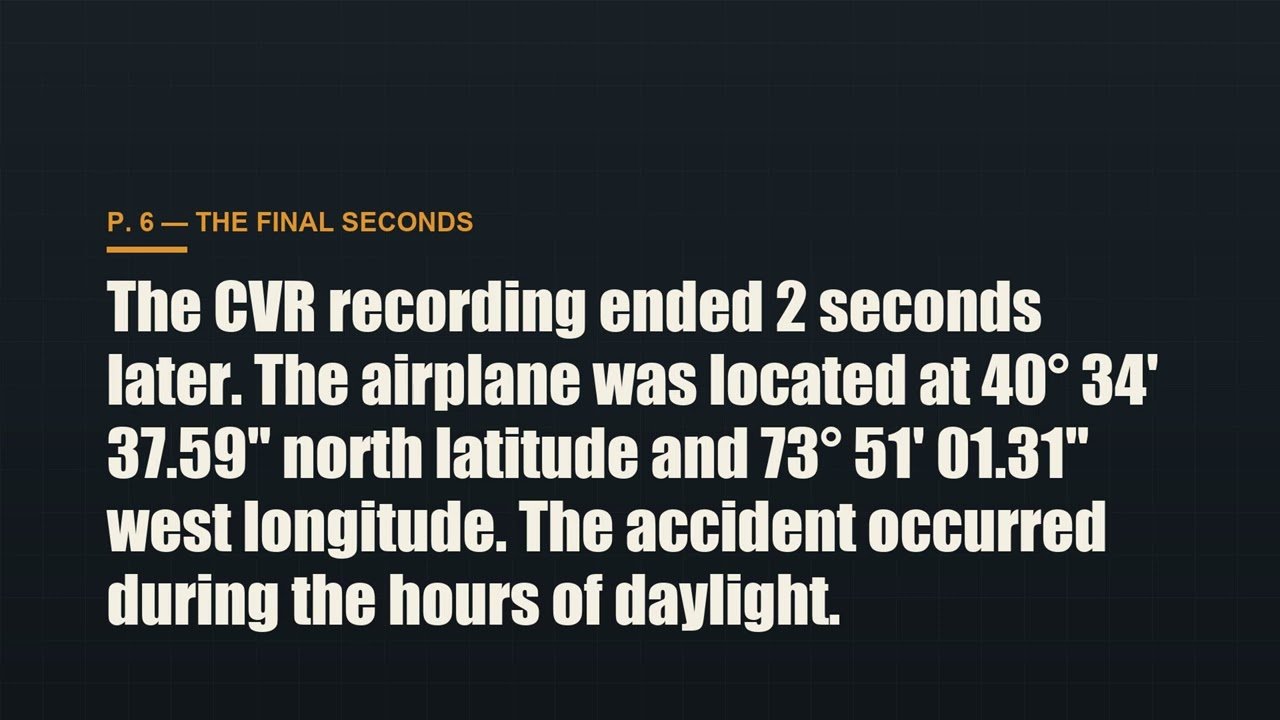
At 09:15:58.4 the rudder was at 10 to 11 degrees right with sideslip of 11 to 12 degrees, and the vertical stabilizer's right rear main attachment fitting fractured. The fin separated and was later found in Jamaica Bay, about a mile from the main wreckage. The NTSB found it had performed as designed and certified. It broke in overstress, at about twice the certified limit load and above the ultimate load. The engines separated afterwards. The aircraft crashed into Belle Harbor, killing all 260 on board and 5 people on the ground, destroying four homes and damaging others.
The rudder limiter
As airspeed rises, the A300-600 limits how far the rudder can move, from 30 degrees below 165 knots to 3.5 degrees at 395 knots. At about 250 knots, full pedal gave about 9.3 degrees of rudder. Airbus used a variable-stop design: the pedal travel and the force needed both shrink at speed, so sensitivity rises with the square of airspeed. At 250 knots, each pound of pedal force beyond breakout commanded 0.93 degrees of rudder, compared with 0.11 on the 737, 0.20 on the 747 and 0.21 on the 777. American Airlines' A300 fleet standards manager testified that pilots believed the limiter would protect the structure, and that the airline had not taught that pedal travel shrank with speed.
Training and the simulator
American's Advanced Aircraft Maneuvering Program included a simulator exercise in which pilots were told they were behind a heavy jet, often a 747. The simulator then rolled the aircraft past 90 degrees and ignored the controls until 50 degrees of bank or 10 seconds. Real reports of large airplanes in wake turbulence showed bank angles usually of 30 degrees or less. The NTSB found this could give an exaggerated view of wake turbulence and encourage aggressive recovery. Separately, the training simulator let pedals travel well past the real aircraft's limit. A captain who had flown with the first officer in 1997 described similar aggressive rudder use after a wake encounter. The NTSB found the first officer tended to overreact to wake turbulence.
Findings and what followed
The NTSB's probable cause named the rudder inputs, with the rudder system design and American's training as contributing factors. Two of the five Board members dissented on the order in which those two factors were listed. In February 2002 the NTSB urged training on the danger of rudder reversals. In 2012 the FAA required A300-600 and A310 rudder system changes or a "stop rudder inputs" warning, and in November 2022 it adopted a design standard requiring powered rudders to withstand a full input followed by three full reversals.
Questions this video answers
What did the NTSB find was the probable cause?
The in-flight separation of the vertical stabilizer from loads beyond its ultimate design, created by the first officer's unnecessary and excessive rudder pedal inputs.
What contributed to those inputs?
Characteristics of the A300-600 rudder system's design and elements of American Airlines' training program.
How many people died?
All 260 aboard and 5 people on the ground, 265 in total.
What changed afterward?
In November 2012 the FAA adopted an airworthiness directive for the A300-600 and A310, and in November 2022 it published a design standard requiring withstanding a full rudder input followed by three full pedal reversals.
Explore related events
Connected by the topic: Pilot error