Aloha Airlines Flight 243: Fatigue Cracks and the NTSB Inquiry
The short version
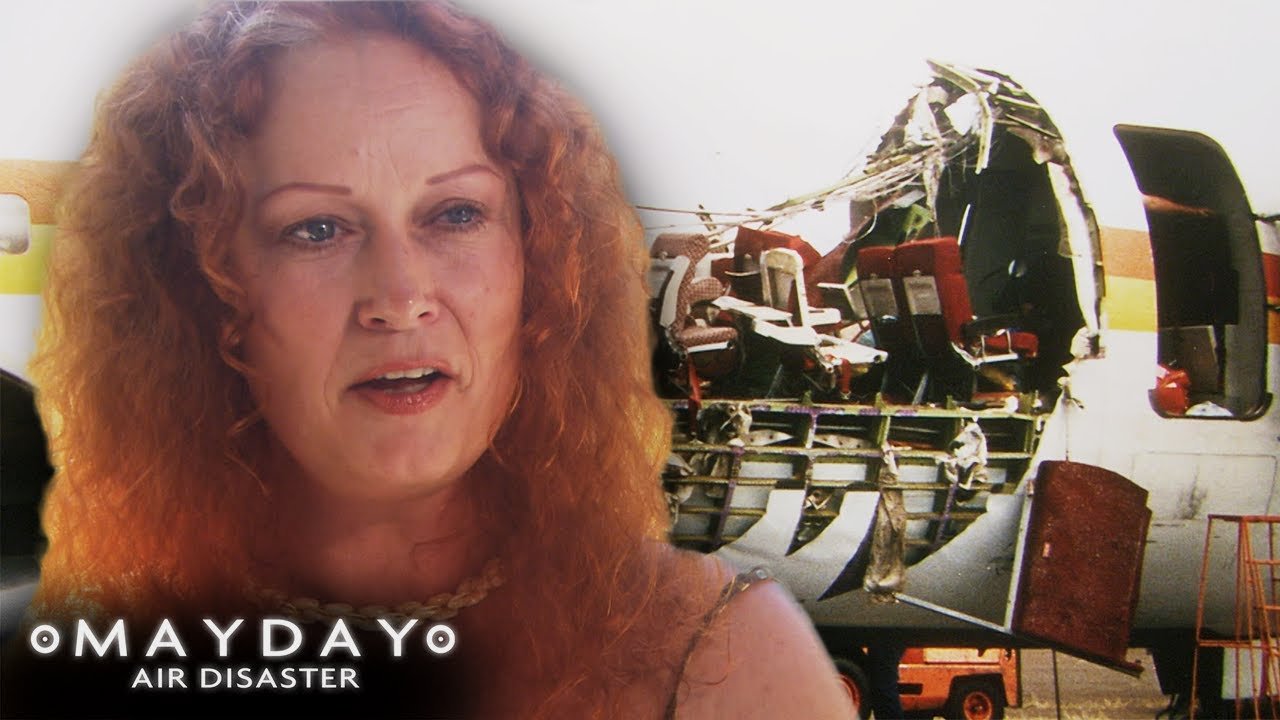
This shorter Mayday cut covers what happened after Aloha Airlines Flight 243 landed on Maui on 28 April 1988 with part of its roof missing. It follows NTSB metallurgists as they find fatigue cracks beside the rivet holes, the maintenance failings at Aloha, and an engineer's "fluid hammer" theory that the NTSB judged scientifically valid but that did not change its probable cause.
Full written account
This film picks up Aloha Airlines Flight 243 just after the landing at Kahului. It does not reconstruct the flight. It shows the damaged 737 on the ramp and then follows the investigation into how a section of fuselage about 18 feet long came away at 24,000 feet.
After the landing
Video taken minutes after landing shows the scale of the damage. A head count by flight attendant Michelle Honda confirmed that senior flight attendant C.B. Lansing was missing. A sea search found neither her nor the missing structure. Seven passengers were seriously hurt. Passengers credit their seat belts for surviving the decompression.
Why the nose stayed on
An investigator explains why the forward fuselage did not break away. The damage was across the top, so as the nose tried to bend down, the remaining structure along the floor was in tension and stayed straight. If the damage had been along the bottom, the same structure would have been in compression and would likely have buckled.
An aircraft flown very hard
The aircraft was number 152 off the 737 production line, delivered in 1969, and designed for a 20-year life and 75,000 flights. It had exceeded that number. Each flight inflates and relaxes the pressurised fuselage, and Aloha's short island hops meant many more cycles per hour than most airliners.
The cracks
NTSB metallurgist Jim Wildey found hairline cracks beside the rivet holes in samples from the remaining fuselage. The 737's skin panels overlap and are bonded with epoxy, with rivets holding them while it sets. Inside the joints there was white corrosion where the bond had failed. Once the bond let go, the top row of rivets carried the load, and fatigue cracks grew there. Boeing had warned operators, Aloha among them, about bonding problems in early 737s, and Hawaii's humid, salty air speeds corrosion. Aloha's inspections were done in pieces, often at night under artificial light, and the FAA's airworthiness directives were hard to turn into clear instructions for mechanics.
The passenger who saw a crack
Investigators interviewed a passenger who had seen a crack to the right of the door while boarding but did not report it. The fatigue cracks investigators found were in that same area. Tear straps every 10 inches were meant to stop any tear and let the cabin vent slowly. The NTSB concluded that so many cracks had formed in a row that they joined and ran straight through the tear straps.
The fluid hammer theory
Honolulu engineer Matt Austin, a specialist in pressure-vessel failures, proposed a different sequence. He argued that a small, designed vent opened directly above C.B. Lansing, that she was drawn into it and briefly blocked it, and that the resulting pressure spike, a "fluid hammer", blew the roof off. A blood-spatter analyst points to stains on the outside of the fuselage. The NTSB said the theory is scientifically valid, but that the evidence still pointed to a near-simultaneous failure of many weak points, and it kept its probable cause. With the missing section never found, the exact moment of failure will probably never be known.
What changed
Aloha's management took most of the blame for its maintenance regime, and the NTSB pressed the FAA to enforce maintenance standards more effectively. Boeing had already changed its manufacturing process. Congress passed the Aviation Safety Research Act, and the industry changed how it inspects and tracks ageing aircraft.
Questions this video answers
What happened on Aloha Flight 243?
A section of the roof of a Boeing 737 blew away in midair over Hawaii, and the airplane landed on Maui after 13 minutes.
Who died?
Flight attendant CB Lansing, who was lost at the moment of decompression; her body was never found.
What did the NTSB conclude?
Cracks caused by fatigue and disbonding in the fuselage joints, combined with poor maintenance, led to the roof opening. The NTSB kept this probable cause.
What is the fluid hammer theory?
Engineer Matt Austin proposed that Lansing was sucked into a safety hole, blocking it and causing a pressure spike. The NTSB called it scientifically valid but did not change its finding.
Explore related events
Connected by the topic: Boeing 737 Classic