Aloha Airlines Flight 243: 13 Minutes From Decompression to Maui
The short version
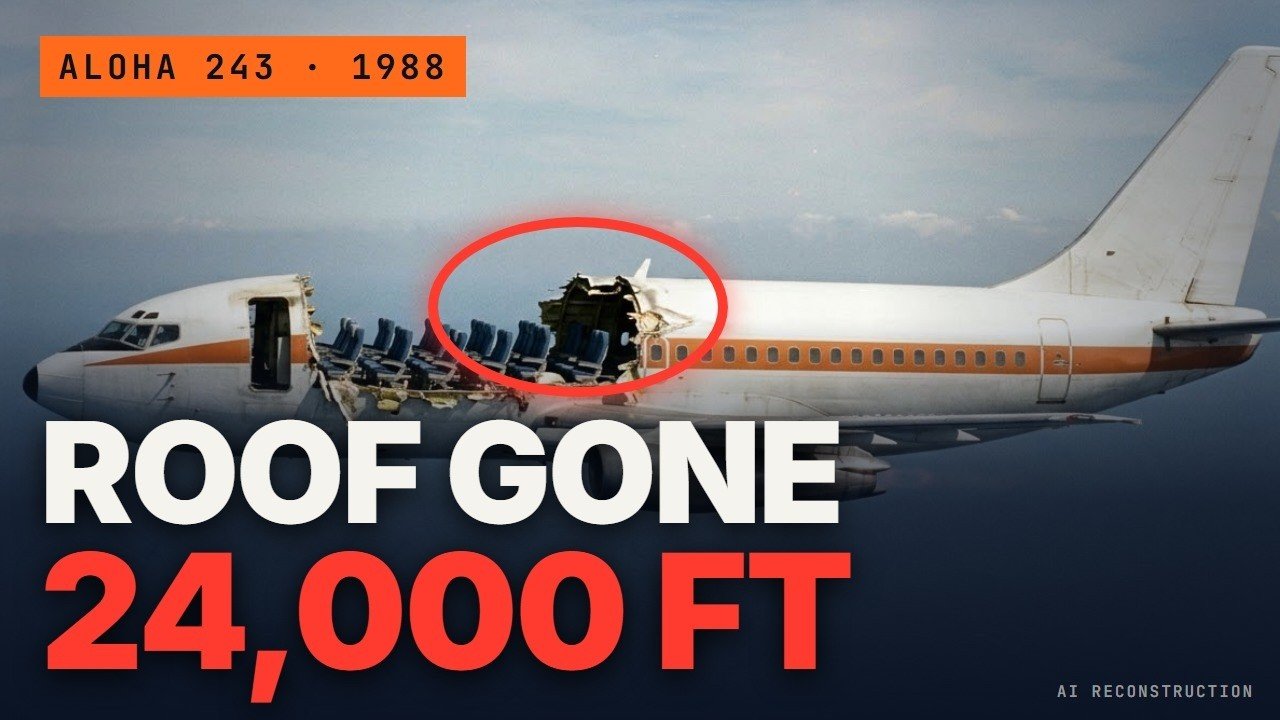
On 28 April 1988 Aloha Airlines Flight 243 lost about 18 feet of its upper fuselage at 24,000 feet. Flight attendant C.B. Lansing was swept out and never found, and 94 of the 95 people on board survived after the crew landed at Kahului. This short film covers the flight and the NTSB's finding on Aloha's maintenance.
Full written account
This ten-minute film tells the story of Aloha Airlines Flight 243 from boarding at Hilo to the investigation, and explains why an airliner's age is counted in flights as well as years.
An airplane counted in cycles
The aircraft was a Boeing 737, N73711, built in 1969, which Aloha called Queen Liliuokalani. Each take-off and landing is one cycle, in which the cabin is pressurised and let down again, and the metal skin swells and shrinks. Inter-island flying meant many cycles a day. By April 1988 this airplane had flown 89,680 cycles in about 35,000 hours. On early 737s, the fuselage skin panels overlap and are joined with rivets and a cold-bonded adhesive. On this airplane, some of that bond had failed in the salty, humid island air, and cracks had begun around the rivet holes.
The crew
Captain Robert Schornstheimer, 44, had about 8,500 hours. First Officer Madeline "Mimi" Tompkins, 36, had about 8,000 and was flying the leg. An air traffic controller rode in the cockpit jump seat. In the cabin, senior flight attendant Clarabelle "C.B." Lansing, 58, had been flying for 37 years. While boarding at Hilo, passenger Gayle Yamamoto noticed a crack in the fuselage skin. She later told investigators, but she said nothing that afternoon.
24,000 feet
Flight 243 took off at 1:25 pm. At 1:46, at 24,000 feet and about 23 nautical miles from Maui, there was a loud whoosh and the airplane rolled left and right. The cockpit door was gone, and where the first-class ceiling had been, the captain could see sky. A section about 18 feet long had torn away. C.B. Lansing, standing near row 5, was swept out. Another flight attendant was struck by debris. Every passenger was seated with a seat belt fastened, which the film says is the reason the toll was not higher.
Thirteen minutes
The captain took control and began an emergency descent to Kahului, unsure how much load the damaged structure could take. Tompkins handled the radio, telling the tower that the crew could not reach the cabin and the passengers would need help. The left engine failed and would not restart. With the gear down, there was no light for the nose wheel. At 1:58:45 the airplane touched down on runway 02. The nose gear was down and the landing was normal. 94 of the 95 people on board survived, 65 were injured, and eight were seriously injured. A local tour company sent vans to take the injured to hospital.
The finding
The missing section was never recovered. Investigators traced the failure to one lap joint on the left side, where the bond had come apart and small fatigue cracks from many neighbouring rivet holes had linked up. The design was meant to stop a single crack and let the cabin vent slowly. A row of small cracks gave it nothing to stop. Aloha inspected mainly by flight hours, at night and a few panels at a time. A 1987 FAA directive had required inspections of some of these joints, but not all. The NTSB found that Aloha's maintenance program failed to detect significant disbonding and fatigue damage, with airline management and FAA oversight contributing. One of the five Board members dissented on how widely the blame should be shared.
Afterwards
The accident led the FAA to start an ageing aircraft research programme, and in 1991 Congress passed the Aging Aircraft Safety Act. The airplane was dismantled at Kahului. In 1995 a garden at Honolulu airport was named after C.B. Lansing.
Questions this video answers
How many people survived Aloha Airlines Flight 243?
Of the 95 people aboard, 94 survived. Senior flight attendant Clarabelle “C.B.” Lansing died after being swept out of the aircraft.
What caused the fuselage to tear open?
Investigators traced the failure to a lap joint where bonding had separated and fatigue cracks had grown around multiple rivet holes. They found that Aloha's maintenance program had failed to detect significant disbonding and fatigue damage.
Where did the crew land?
Captain Robert Schornstheimer and First Officer Madeline “Mimi” Tompkins landed on runway 02 at Kahului on Maui.
Had anyone noticed damage before departure?
Passenger Gail Yamamoto saw a crack in the fuselage while boarding at Hilo but did not report it before the flight.
What other problems did the pilots face?
The left engine failed during descent and could not be restarted. The nose-wheel indicator also failed to illuminate, although the nose wheel was down when the aircraft landed.
Explore related events
Connected by the topic: Boeing 737 Classic