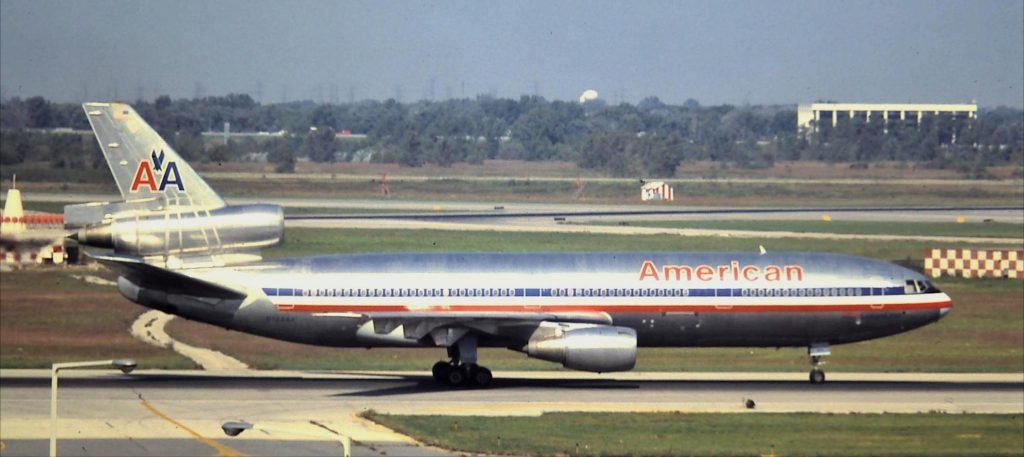
United Airlines Flight 232: Steering a DC-10 With the Throttles

The short version
Mentour Pilot explains how the crew of United Airlines Flight 232 flew a DC-10 for 44 minutes with no hydraulics after its tail engine failed on 19 July 1989. He covers the DC-10's hydraulic design, how differential thrust can turn and pitch an airliner, the phugoid problem and the crew's teamwork, and the changes that followed.
Full written account
This Mentour Pilot episode explains United Airlines Flight 232, the DC-10 that crash-landed at Sioux City, Iowa, on 19 July 1989 after losing all of its hydraulics. The narrator, an airline captain, spends much of the video on the aerodynamics of steering with engines, and on the crew resource management that he sees as the reason so many people survived.
A design without a manual backup
The video starts with the DC-10's flight controls. Unlike some older aircraft, it had no mechanical backup: the control surfaces were moved only by hydraulic actuators, supplied by three independent systems. The narrator explains why designers believed three systems were enough, and the weakness that the accident exposed: towards the tail, all three systems' lines ran close together, near the No. 2 engine.
The fan disk
There were 296 people on board. At 15:16, at 37,000 feet, a fatigue crack in the No. 2 engine's fan disk, which inspections at United had not found, reached a critical size. The disk split and disintegrated, and debris tore through the tail, rupturing all three hydraulic systems. The video follows the crew's first reactions: the engine shutdown checklist, and the second officer's realisation that the hydraulic quantity and pressure were zero in every system.
Steering with thrust
The narrator explains why the wing engines, mounted below the centre of gravity, can control the aircraft. Adding power on both pitches the nose up. Adding power on one side yaws the aircraft and, through the yaw, rolls it. The crew found that by pulling back the left engine they could stop the roll to the right. It was crude control, and the aircraft also kept going through long phugoid cycles, in which it gains speed in a dive, climbs, slows and dives again. The video explains why this motion is so hard to damp with the engines alone.
Denny Fitch
An off-duty DC-10 training captain, Denny Fitch, was on board as a passenger and offered to help. Captain Al Haynes invited him to the cockpit and gave him the throttles. The narrator points out that Fitch had studied earlier accidents involving a total loss of hydraulics and had thought about what he would do, which meant he was not starting from nothing.
The approach
Controllers vectored the aircraft to Sioux City. The crew made wide right turns because left turns were harder. They knew they would land much faster than normal, at about 220 knots, with a high sink rate. The narrator explains why the touchdown at the airport, rather than in open country, mattered so much: the emergency services were ready and waiting.
What changed
The narrator stresses Haynes's use of every resource available, from his flight crew and the cabin crew to air traffic control and the extra pilot. He then describes the design changes to the DC-10 that followed, including hydraulic fuses intended to keep at least some control if a system is damaged. For another aircraft that lost its hydraulics, see Japan Air Lines Flight 123.
Questions this video answers
What caused the failure of United Airlines Flight 232?
A fatigue crack that grew from a small metallurgical imperfection in the number two engine's fan disc caused the disc to split. The fan section disintegrated and shrapnel ruptured the hydraulic lines.
How many people survived?
296 people were on board and 185 survived, including all four members of the cockpit crew.
How did the crew control the DC-10 without flight controls?
They used differential thrust, raising thrust on one engine and reducing it on the other, to control roll and pitch after all three hydraulic systems lost pressure.
Who was Dennis Finch?
Dennis Finch was a DC-10 line training captain travelling as a passenger. He went to the flight deck, handled the thrust levers and had previously practiced differential thrust in a simulator.
What changed after the accident?
Hydraulic fuses were introduced to trap fluid in the undamaged parts of the system, and the number three hydraulic system was changed so that fluid is stopped from flowing to the rear if its level drops.
Explore related events
Connected by the topic: McDonnell Douglas DC-10