Malaysia Airlines Flight 370
On 8 March 2014 Malaysia Airlines Flight 370, a Boeing 777 flying from Kuala Lumpur to Beijing with 239 people on board, stopped communicating less than 40 minutes after takeoff, turned back across Malaysia and flew on for about seven hours, tracked only by satellite signals. The aircraft is believed to have come down in the southern Indian Ocean and has never been found, and the official investigation could not establish why it disappeared.
The sequence of events
All times MYT
-
Watch this moment · 5:20
Takeoff from Kuala Lumpur
MH370 took off from runway 32R at Kuala Lumpur International Airport for Beijing with 227 passengers and 12 crew, and climbed towards waypoint IGARI over the South China Sea.
-
Watch this moment · 9:20
01:19 MYTapproximately
"Good night, Malaysian three seven zero"
Approaching IGARI, the handover point to Vietnamese air traffic control, the crew acknowledged the call to change frequency. It was the last radio message from the aircraft.
-
Watch this moment · 12:25
01:21 MYTapproximately
The transponder stops
The aircraft disappeared from civilian secondary radar near IGARI. Malaysian military radar saw it turn back to the south-west and cross the Malay Peninsula.
-
Watch this moment · 36:12
02:22 MYTapproximately
Last radar contact
After passing Penang and flying north-west up the Strait of Malacca, the aircraft was last seen on military radar over the Andaman Sea.
-
02:25 MYTapproximately
The satellite link comes back
The aircraft's satellite communications system logged back on to the Inmarsat network. From then on it answered hourly automatic 'handshakes', which later showed it had flown on for hours.
-
08:19 MYTapproximately
The last satellite signal
A final partial handshake placed the aircraft on an arc across the southern Indian Ocean, consistent with the time its fuel would have run out. No further signal was received.
-
Watch this moment · 7:27
The first debris is found
A flaperon from a Boeing 777's right wing washed ashore on Réunion Island and was confirmed to come from MH370, the first physical proof that the aircraft had come down in the ocean.
-
17 January 2017
The underwater search is suspended
Malaysia, Australia and China suspended the official search of the seabed after almost three years. A privately run search by Ocean Infinity in 2018 also found nothing.
-
Watch this moment · 13:05
The safety investigation report
The Malaysian investigation team published its report. It said it was unable to determine the real cause of the disappearance.
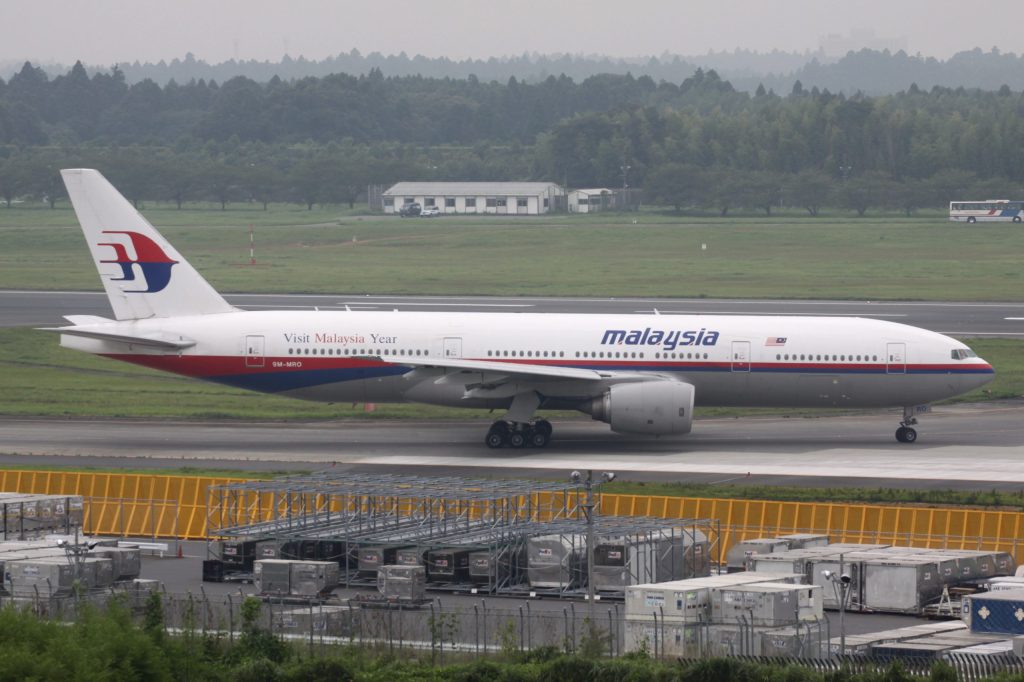
Key facts
| Aircraft | Boeing 777 |
|---|---|
| Aircraft variant | Boeing 777-200ER, 9M-MRO |
| Flight number | 370 |
| People who died | 239 |
| People on board | 239 |
| Were there survivors? | No |
| Phase of flight | Cruise |
Cause not established
Investigators could not determine the cause. Theories in the videos are kept separate from official findings.
More coverage
-
Air Crash Investigation
Malaysia Airlines Flight 370: What Is Known Twelve Years Later


Questions and answers
What happened to MH370?
It is not known. The evidence shows that about 40 minutes after takeoff, the aircraft's transponder and other communications stopped, it turned back across Malaysia, flew north-west up the Strait of Malacca, and then, according to the satellite data, flew south for about six more hours until its fuel ran out over the southern Indian Ocean. Debris from the aircraft has washed up in the western Indian Ocean, but the main wreckage has not been found.
What did the official investigation conclude?
The Malaysian safety investigation team said in its July 2018 report that it was unable to determine the real cause of the disappearance. It found it more likely that the aircraft's communications were switched off manually or lost through a power interruption than that they failed technically, and its simulations could only match the turn back if the aircraft was being flown by hand. Without the wreckage and the flight recorders, it could not go further.
How do investigators know the plane flew south?
The aircraft's satellite communications system kept answering automatic hourly 'handshakes' from an Inmarsat satellite. The timing of each signal placed the aircraft on an arc at a given distance from the satellite, and small frequency shifts in the signals showed the aircraft was heading south. The last signal, at 08:19, placed it on the seventh arc across the southern Indian Ocean.
Has any wreckage of MH370 been found?
Yes, but only small pieces. The first, a right-wing flaperon, washed up on Réunion Island on 29 July 2015 and was confirmed to come from MH370. More pieces have been found on the coasts of eastern Africa and islands in the western Indian Ocean. The main wreckage and the flight recorders have never been found.
What are the theories about MH370, and what is the evidence?
The main theories are a deliberate act by someone on board, often said to be the captain, and an emergency such as a fire or depressurisation that incapacitated the crew while the autopilot flew on. The radar track and the turn are consistent with someone flying the aircraft at the time, but the investigation did not say who, or why. Other claims, such as a landing or shoot-down near Diego Garcia, have no supporting evidence. Newer analyses of amateur radio (WSPR) and hydrophone data have been proposed to narrow the search area, but none has been accepted by an aviation authority. Read more in our guide to plane crashes with disputed causes.
What changed after MH370?
The disappearance led to new international rules on tracking airliners, so that an aircraft's position is known more often over remote oceans. The searches have also continued: Malaysia has contracted Ocean Infinity for further searches on a no find, no fee basis.
Sources: The facts and written text on this page come from the 3 videos on this page, by Green Dot Aviation, Mentour Pilot, Air Crash Investigation.