Jet Airways Flight 555: Seven Approaches and a Fuel Emergency
The short version
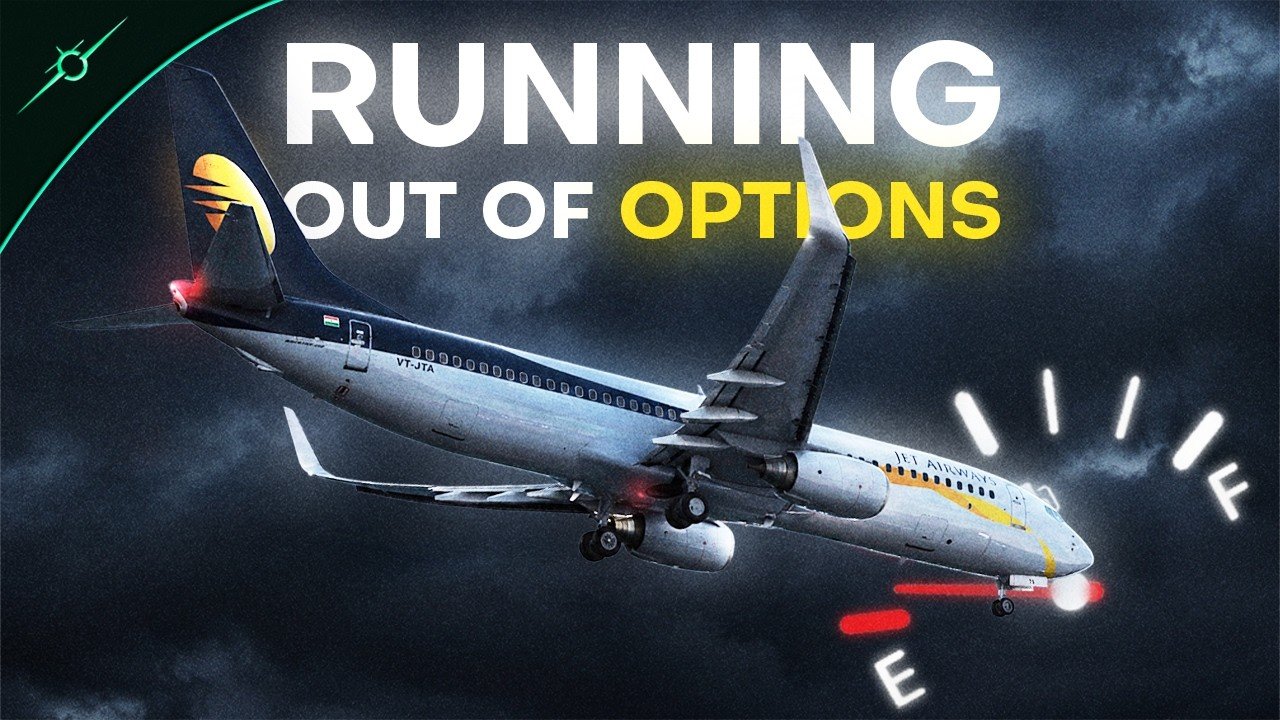
Fog at Cochin forced Jet Airways Flight 555 to go around three times, and the crew then diverted to Trivandrum, where the weather was no better. Four more attempts followed, a Mayday for low fuel, and a final low-level turn through terrain warnings before the 737 landed with 349 kg of fuel. The video explains each decision that narrowed the crew's options and the airline policy gaps behind them.
Full written account
On the morning of 18 August 2015, Jet Airways Flight 555 from Doha made seven approaches before it landed in Trivandrum, India, with 349 kg of fuel left, a few minutes of flying. All 150 people on board were unhurt. The video traces how a crew with plenty of fuel and several options gradually ran out of both.
A late flight from Doha
The Boeing 737-800 carried 142 passengers and 8 crew. The captain, 40, had over 6,000 hours, almost all on the 737-800. The first officer, 25, had just under 1,500 hours. The flight left Doha at 22:40 local time for a four-and-a-half-hour flight, due at Cochin around 05:00.
The flight plan fuel came to 15,295 kg. Because mist was forecast at Cochin, the captain added 750 kg for holding and rounded up to 16,100 kg, giving about six hours' endurance. The planned alternate was Bangalore.
Three approaches at Cochin
Cochin reported 3,500 m visibility in haze. The crew flew the ILS to runway 27, which allowed a descent to 320 ft before the runway had to be in sight. It never appeared, and the captain went around late, at 256 ft. Fuel was 4,699 kg, with 3,306 kg the minimum needed to reach Bangalore.
During the second approach the crew discussed Trivandrum. The first officer pointed out that it had no ILS, only a VOR approach that needed better visibility. The captain judged its reported 3,000 m was enough. The second approach also failed.
In the hold, with 3,919 kg, the captain switched the alternate to Trivandrum. Because it was closer than Bangalore, the minimum diversion fuel dropped, which bought time to wait for the mist to burn off. The first officer worried the visibility could fall at Trivandrum too; the captain said they could always go to Coimbatore. Neither pilot checked Coimbatore's weather.
Most airlines limit crews to two missed approaches in poor visibility before diverting. Jet Airways had no such rule. Visibility at Cochin fell to 2,000 m, the third approach failed, and at 06:20 the 737 turned south with 2,644 kg, 30 kg above the minimum for Trivandrum.
Trivandrum is no better
On first contact, Trivandrum reported 1,500 m. Its VOR approach to runway 14 needed a runway visual range of 2,100 m. The captain planned to convert the reported visibility upwards, which is allowed only with high-intensity approach lighting. The tower said runway 14 did not have that system, but the captain went ahead with the conversion.
He was also too high and asked for a 360-degree orbit to lose height, which took about eight minutes. The crew reported minimum fuel. The VOR approach failed at 06:49, and about 40 seconds later, below 1,300 kg, they declared a Mayday.
Two visual circuits
To save fuel the captain flew visual circuits along the coast instead of the published missed approach. On the first, the runway appeared too late, with the jet too high and too far right. On the second, it appeared off to the left during the turn; the captain banked hard enough to set off the bank angle warning, but could not line up. After this sixth go-around, 662 kg remained.
The seventh attempt
The captain climbed only to about 700 ft and turned back to land in the opposite direction on runway 32. Low over trees and buildings, the ground proximity system called "terrain, pull up". A go-around now risked running out of fuel, so the captain pressed on and the first officer switched the terrain warning off. Asked whether he could see the runway, the captain replied: "Just going blindly." The lights appeared at the last moment, off the centreline, and he banked right to line up. The 737 touched down at 07:09.
The crew refuelled and flew on to Cochin once the weather there improved.
What the investigation found and what changed
India's AAIB found that the lack of a company limit on approaches, and of rules for changing the alternate in flight, led to seven approaches, three of them visual approaches below minima, and the disregard of several terrain warnings. Both pilots were suspended during the investigation, and the captain was demoted for a time. Jet Airways set limits on approaches, defined how alternates can be changed and added low-fuel scenarios to simulator training.
For another flight that ran short of fuel through a chain of decisions, see Air Canada Flight 143 and Air Transat Flight 236, where the fuel problems had different causes.
Questions this video answers
Why did Flight 555 divert from Cochin?
The crew could not see the runway during three approaches and diverted to Trivandrum as fuel diminished.
Why couldn't the aircraft land automatically at Cochin?
Cochin’s instrument landing system did not provide the precision needed for an automatic landing.
Did the aircraft run out of fuel?
No. It landed after declaring a fuel emergency; the last stated fuel quantity before the final approach was 660 kilograms.
Was anyone killed?
No. Everyone aboard was safe after the landing.
What changed after the investigation?
Jet Airways revised its approach-limit policy and alternate-airport redesignation criteria, and introduced low-fuel simulator scenarios.
Explore related events
Connected by the topic: Boeing 737-800