American Airlines Flight 191: The Forklift Shortcut and the Slats
The short version
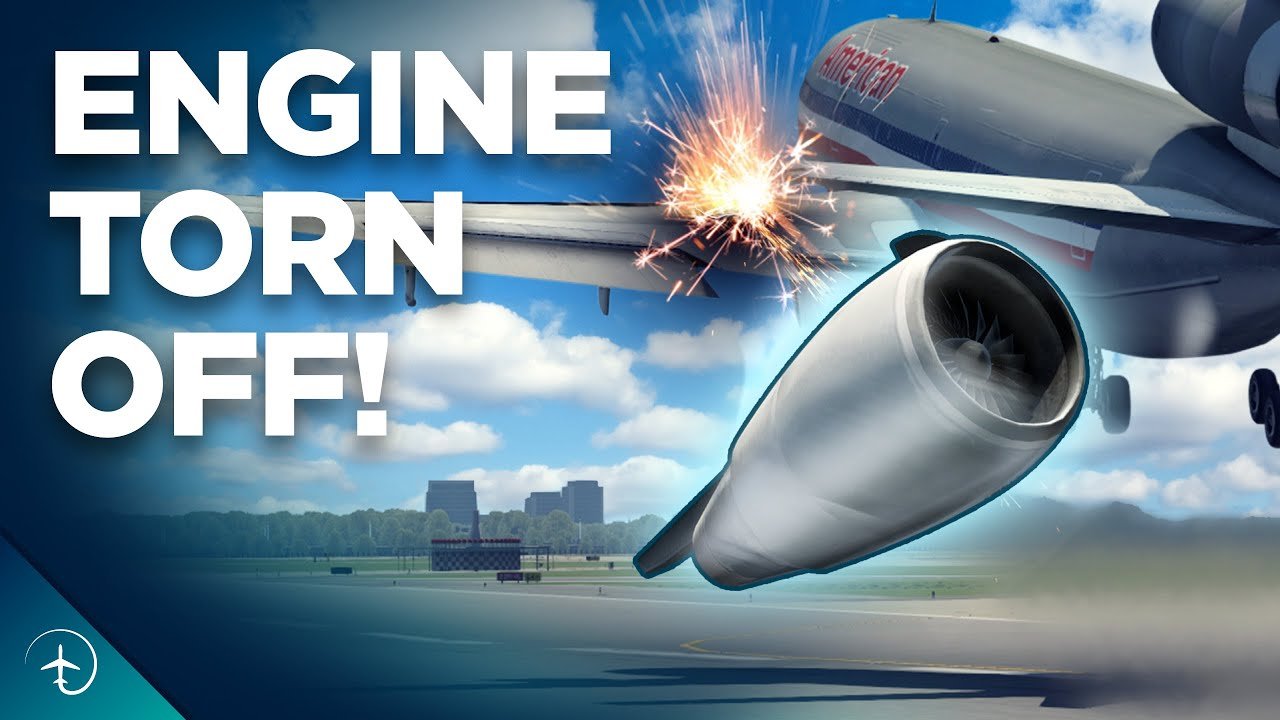
Mentour Pilot explains American Airlines Flight 191, the DC-10 that lost its left engine on takeoff from Chicago O'Hare on 25 May 1979. He goes through the maintenance shortcut that cracked the engine pylon, the 50-second flight, and why the retracted slats and a dead stall warning turned a survivable engine loss into the worst air disaster in US history.
Full written account
This Mentour Pilot episode explains American Airlines Flight 191 in two parts: the maintenance work that damaged the aircraft weeks before, and the 50 seconds of the flight itself. The narrator is an airline captain, and the second half concentrates on what the crew could and could not know.
The pylon and the shortcut
The DC-10-10 had three engines, one under each wing and one in the tail. Each wing engine hangs from a pylon attached to the wing at several points. McDonnell Douglas's guidance said to remove the engine first and then the pylon. American Airlines and Continental instead removed the engine and pylon as one unit, supporting the assembly on a forklift, which saved many hours of work. The narrator explains why that was risky: the forklift operator had to hold the heavy assembly perfectly still while the attachments were undone, and any movement could load the attachment fittings.
March 1979
The video describes the maintenance of the accident aircraft between 29 and 31 March 1979. The work was interrupted at a shift change, and the day shift found the rear attachment point in contact with the wing fitting. The damage, a crack in the pylon's rear bulkhead, was not noticed afterwards, and the aircraft returned to service. The narrator notes that similar cracks had already been found on other aircraft, but they had been put down to individual mistakes, not to the procedure.
Takeoff
Flight 191 was a full flight to Los Angeles. The video introduces the crew, including Flight Engineer Alfred Udovich, and explains the takeoff speeds they had calculated. At rotation the left engine and pylon tore away, went up over the wing and fell to the runway, taking part of the leading edge with them and cutting electrical and hydraulic lines. The captain's single word, "Damn", was the last thing the cockpit voice recorder captured, because it lost power.
The slats
The narrator then explains the cause of the crash. The leading edge slats on the left wing were held out by hydraulic pressure, and with the lines cut, air loads pushed the outer slats back. That raised the left wing's stall speed to about 159 knots. The crew, as trained for an engine failure, flew the climb speed, which was lower than that. At about 350 feet the left wing stalled and the aircraft rolled. The loss of the No. 1 generator had disabled the stick shaker on the captain's side, and the slat disagreement warning, so the crew had no indication of a stall. The narrator argues that a crew who heard a stall warning would likely have lowered the nose and kept the speed above 159 knots.
The investigation
The aircraft crashed into a field just beyond the airport, about 50 seconds after the takeoff roll began. Investigators found the separated engine and pylon beside the runway, and other aircraft maintained the same way turned out to have similar cracks. The video ends with the lessons for maintenance: report damage, and question a procedure that keeps producing it. For other DC-10 accidents, see United Airlines Flight 232.
Questions this video answers
What caused the engine to separate on American Airlines Flight 191?
Seconds before rotation, the aft bulkhead attachment point of the number one engine pylon failed, and the engine detached from the left wing.
How did the pylon get damaged?
A stress fracture was likely caused during maintenance in Tulsa, when the engine and pylon were removed as one unit with a forklift and the aft pylon was pushed up toward the wing attachment.
Why did the aircraft stall?
The detached engine severed hydraulic lines, so the left wing's leading edge slats retracted. Stall speed on that wing rose to 159 knots, above the V2 speed of 153 knots they were flying toward.
Why was there no stall warning?
Loss of electrical power from the number one engine disabled the captain's stick shaker and the slat position indicator, so the crew had no indication of the stall.
How many people died?
All 271 people on board died, and two more people on the ground were killed.
Did investigators blame the pilots?
Investigators concluded the pilots performed well and did what was expected. In simulator trials, crews that received a stall warning managed to control the aircraft.
Explore related events
Connected by the topic: McDonnell Douglas DC-10
