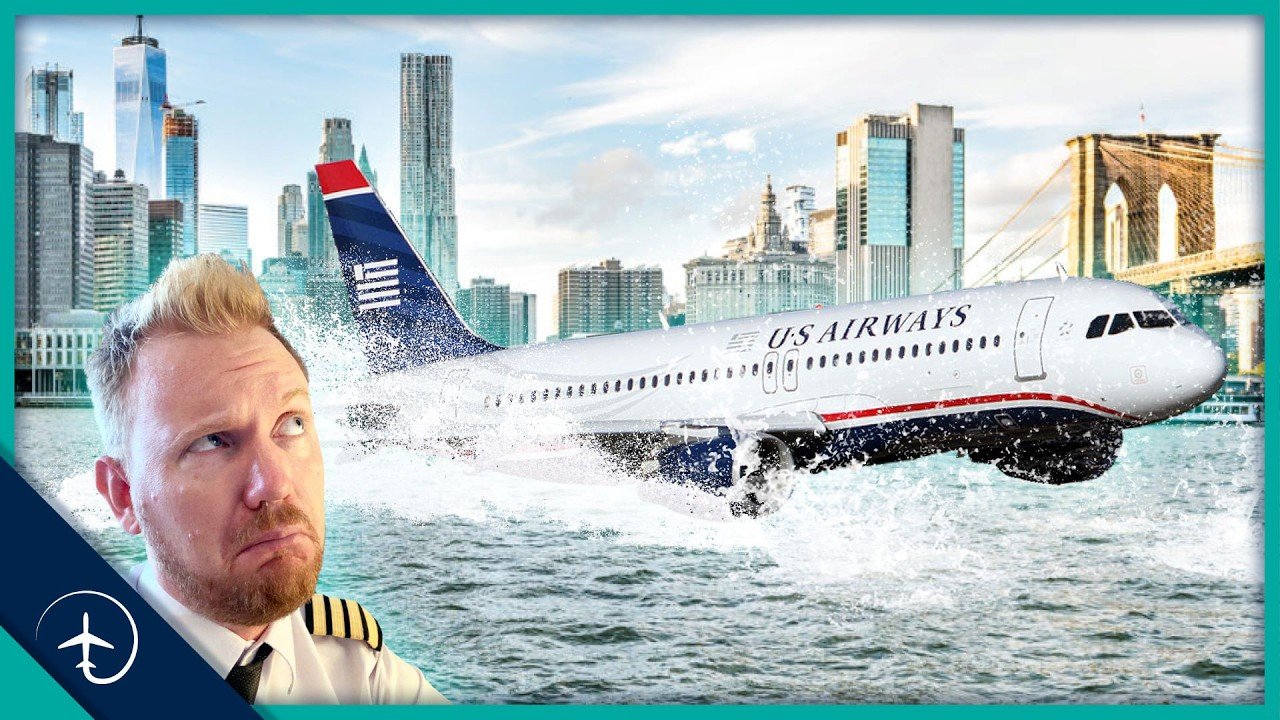
US Airways Flight 1549: A Pilot Explains the Hudson Ditching
The short version
Mentour Pilot goes through the flight of US Airways 1549 on 15 January 2009 from a working airline pilot's point of view, from the bird strike over the Bronx to the ditching on the Hudson. He explains the dual engine failure checklist, how the crew split their tasks, and why the NTSB found that turning back was not possible. The video ends with the radio recordings.
Full written account
This Mentour Pilot episode explains US Airways Flight 1549, the Airbus A320 that ditched on the Hudson River on 15 January 2009 after both engines were damaged by birds. The narrator is an airline captain, and the video concentrates on what the two pilots were doing, second by second, and why their choices worked. The final minutes play the radio recordings from that afternoon.
The crew and the aircraft
There were 150 passengers on board, including a baby on his mother's lap, and five crew. Captain Chesley Sullenberger was a former military pilot. First Officer Jeffrey Skiles had more than 15,000 hours on other types but had only just started on the A320 and had recently passed his skill test. The narrator points out a piece of luck: this aircraft was fitted for flights over water, with slide/rafts at the doors, although its route did not require them.
The bird strike
About two minutes after takeoff from runway 4 the captain called "Birds!", followed by thumps and a loss of engine noise. The video explains engine bird-strike certification. The birds used in certification tests at the time were much lighter than a Canada goose, which weighs several times as much, and examinations after the accident found goose remains in both engines.
Twelve seconds
The narrator stresses how much the crew did in the first seconds. The captain started the auxiliary power unit, which kept electrical power and the fly-by-wire protections available, then took control, as US Airways procedures expected in an emergency. The first officer began the engine dual failure checklist from the Quick Reference Handbook. The mayday call was not heard by air traffic control because another aircraft was transmitting at the same moment. The video explains that the A320's dual engine failure checklist was written for losing both engines at cruising height, with plenty of time, not at 3,000 feet.
LaGuardia, Teterboro or the river
Controllers offered LaGuardia and then Teterboro. The narrator explains why turning back would have used up height the crew could not spare: if they had tried for LaGuardia and fallen short, there would have been nowhere left to go. The NTSB's simulations later showed that a successful return was only possible with an immediate turn and no time to think.
The approach to the water
While the captain flew and planned, the first officer worked the checklist and called out speed and height. Ground proximity warnings sounded as the aircraft descended over the city, and they masked other warnings. With the river close, the captain asked "Got any ideas?" and the first officer replied "Actually, not." The narrator sees this exchange as an example of good crew resource management. The aircraft touched down with its speed below the target, and the rear of the fuselage was damaged. The left engine broke away.
The evacuation and the report
Water came in at the back, so the rear exits could not be used. Passengers left through the forward doors and the overwing exits, and the pilots made a final sweep through the cabin. The video reads out the NTSB's probable cause and contributing factors, then describes changes to training that followed, which the narrator says reached his own Boeing fleet.
Questions this video answers
What caused US Airways Flight 1549 to lose power?
A flock of Canada Geese was ingested into both engines about two minutes into the flight, causing a near-total loss of thrust.
Did everyone survive?
All 150 passengers and five crew survived; the video says there was enough room for all of them in the dinghies and on the wings.
Why did the crew not return to LaGuardia or reach Teterboro?
Captain Sullenberger had the Hudson River in view as the open option; Teterboro was about nine miles away, and a turn back to LaGuardia would have cost altitude over a densely populated area.
What did the NTSB conclude?
The NTSB named the ingestion of large birds into each engine as the probable cause, with contributing factors affecting the fuselage damage and the unavailable aft slide/rafts.
Why did starting the APU matter?
Captain Sullenberger started the APU from memory two seconds after the engines rolled back; without it the aircraft would have had only ram air turbine power and would have gone into alternate law without Alpha floor protection.
Explore related events
Connected by the topic: Airbus A320